Abstract Pornography Doesn’t Exist
Sometimes a sentence implants itself in your brain and refuses to leave. William Burroughs’ philosophy should be approached with skepticism; nevertheless, there is some truth in his claim that language is a virus. Words exist for the sole purpose of infecting the host’s mind, multiplying, and propagating forth to the next unwitting victim. The particular fragment of language which has infected my thinking over the last few weeks is this: “There’s no such thing as abstract pornography.”
This seemingly uncontroversial claim comes from a 2012 essay by the philosopher Hans Maes titled Who Says Pornography Can’t Be Art? I am not going to argue with Maes on any matters of substance. I’m hardly qualified to do so, for one thing. For another, I quite like his essay; it was one of the main references used in my previous discussion about the blurred boundaries between Art and Pornography. Rather than debunk the claim that Abstract Pornographic Art doesn’t exist, I want interpret it as a challenge. What would Abstract Porn look like if it did exist? For the remainder of this essay, I will outline my thought process and present some examples of what it might mean to blur the lines between Pornography and Abstract Art.
Obviously, any approach to creating Pornographic Abstract Art will hinge on how one chooses to define each of these three terms. For the purposes of this project, I will accept the premise that Pornography is sexually explicit and seeks to focus the viewer’s attention on anatomical detail. Erotic Art might well contain nudity or graphic depictions of genitalia; however, the viewer’s attention is always directed away from the mechanics of sex and toward the human, their subjective experiences, their emotions, etc. Pornography is mostly about revealing, in this way of thinking, while Erotic Art is mostly about that which has been concealed.
It must be admitted that the above distinction between Erotic Art and Porn is flawed. And, indeed, I do not accept that these two labels are mutually exclusive. But we need not let such subtleties interfere the task at hand. After all, genre definitions are inherently blurry. We surely agree that Horror is meaningfully different than Comedy, for example; nevertheless, many films exist which can be described as Horror/Comedy. The fact that these categories are not mutually exclusive doesn’t mean they’re meaningless or identical. So it is with Art and Pornography.
Having decided on a working definition of Pornography, we will also need to define Abstract Art. For the purposes of this essay, art becomes abstract as it leans away from literal depiction. The best known works of Pollock, Mondrian, and Rothko might conjure real emotions in the viewer; however, these images should not be understood in any kind of one-to-one correspondence with a real-world scene. This is good enough a definition for my purposes: To greater or lesser degree, Abstract Art is non-representational.
With these definitions in order, it is obvious why Pornography and Abstract Art are mutually exclusive categories. The former is defined by its graphic representation of sexual acts and genitalia, the latter by its non-representational nature. The challenge, for the remainder of this essay, will be reconciling this contradiction.
There is also another challenge, specific to my chosen medium. Photography lends itself more naturally to literal representation of real-world things than painting or poetry, for example. As such, the camera is inherently more suited to Pornography than Abstract Art. But we needn’t be too discouraged—Abstract Photography is already a mature art form. Since at least the 19th century, photographers have employed various approaches to making the camera’s output less straightforwardly connected to the material world, ranging from extreme magnification to blurring to compositing to superposition to unorthodox compositional choices.
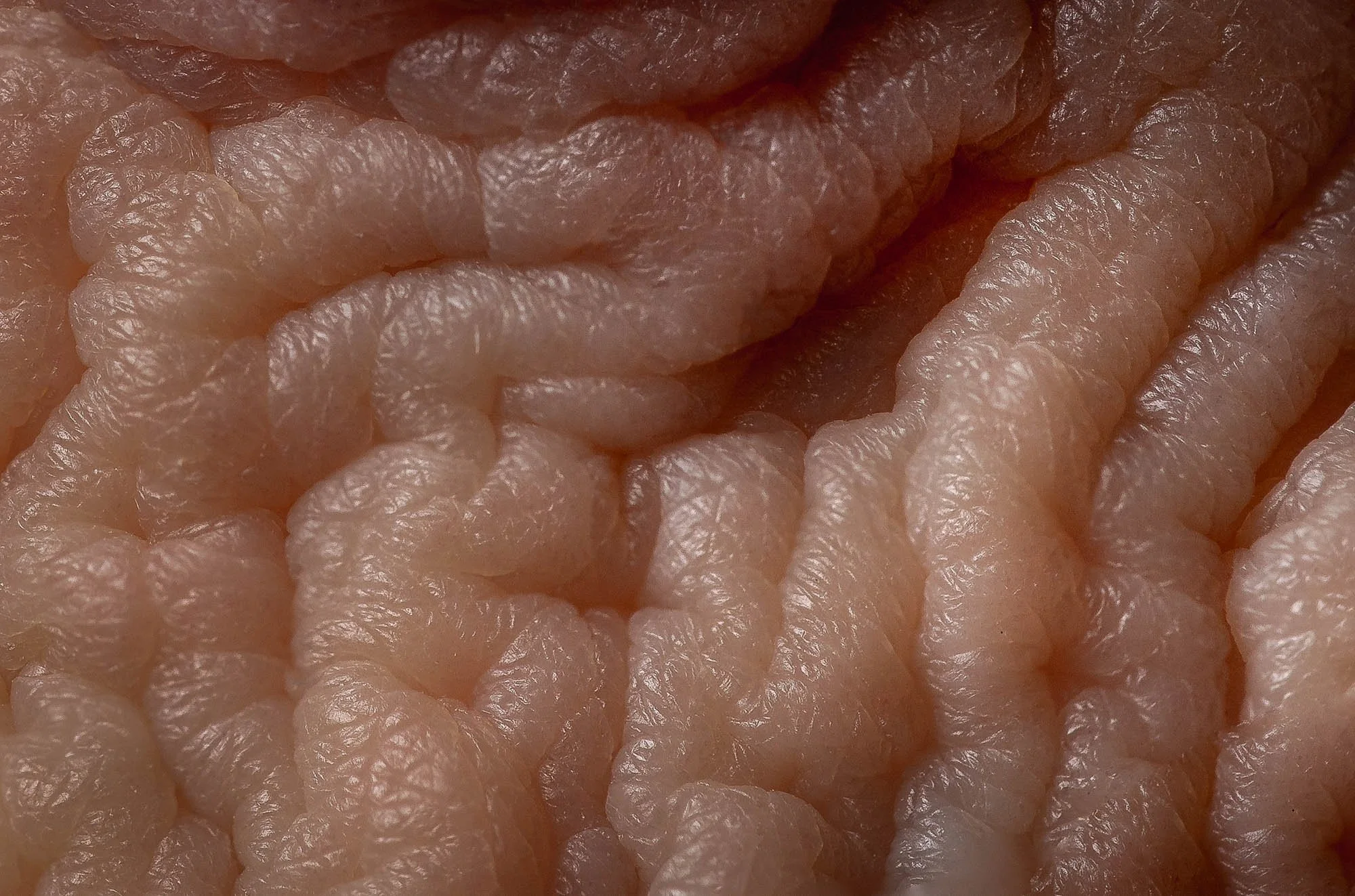
A Study of the Areola, by Neal Auch
My (admittedly flawed) approach to bridging the gap between Porn and Abstract Art is this: graphic photographs of sexual organs presented at extreme magnification and composed in such a way as to create some sense of ambiguity concerning subject matter. I will consider this series of photographs to be a success if a viewer who is reasonably familiar with normal human anatomy might, nevertheless, sometimes find themselves uncertain about what they are looking at. What I’m hoping for is some pause between the moment of laying eyes on a picture, and the moment of understanding exactly what it depicts. It is in that liminal space, that time of confusion, where the mind can wander and make abstract associations. One might notice that the folds and textures of labia evoke mountain ranges or internal organs, for example. But perhaps once the viewer has sat with these images for an extended period of time, such abstract associations might evaporate and be replaced by thoughts of a more carnal nature.
Put differently: this project attempts a balancing act. The more abstract an image of genitalia becomes, the less its erotic potential. But my hope is that there’s some middle ground, some space where an image is just disembodied enough to be meaningfully abstract and yet, at the same time, still capable of conjuring erotic thoughts. Indeed, for some readers these images might summon to mind the view enjoyed while performing oral sex on a partner.
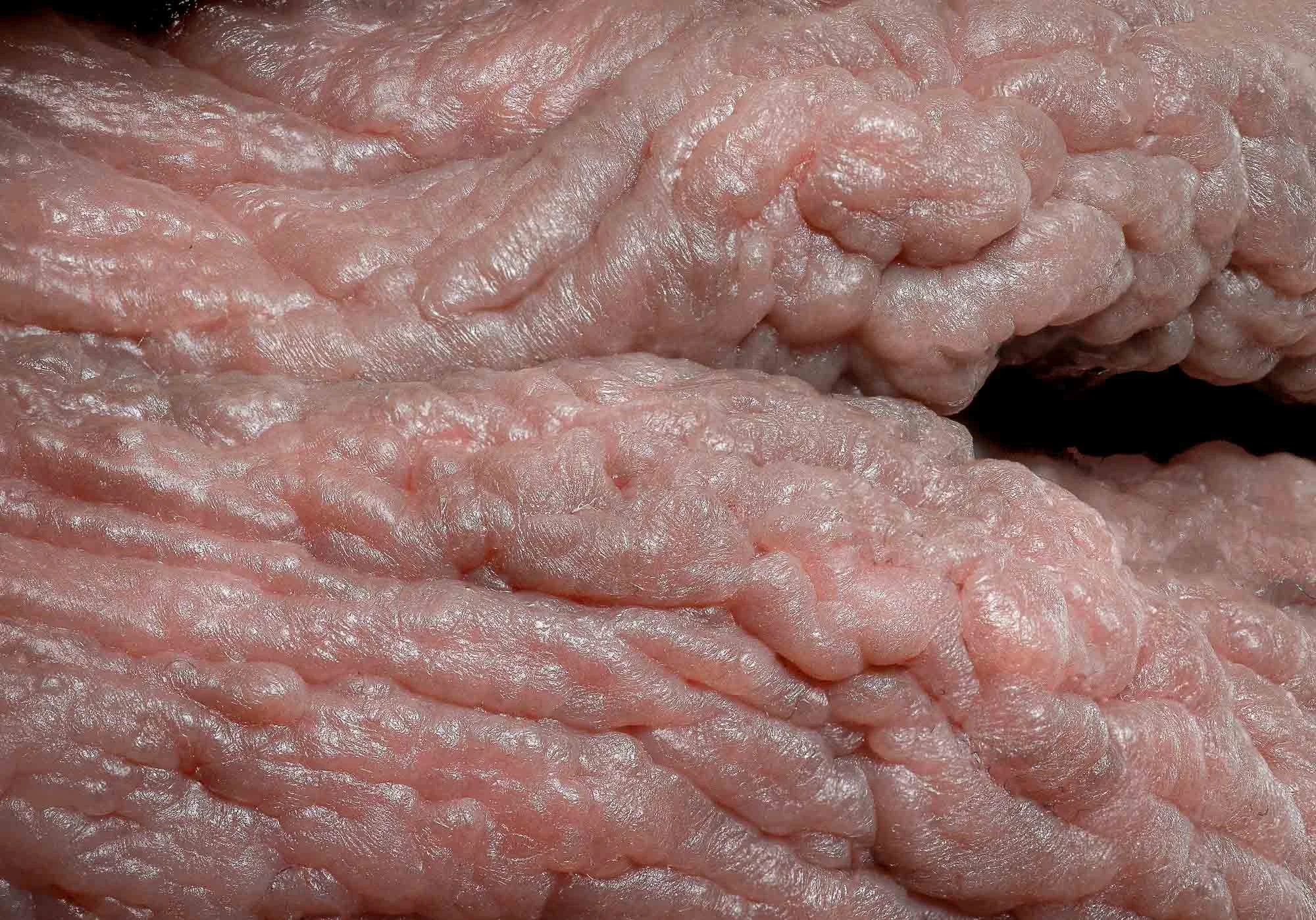
A Study of the Labia, by Neal Auch
It might be that abstracting the body through extreme magnification obliterates certain conventional notions of beauty and eroticism. But it seems clear to me that these are replaced by newer—more surreal—counterparts. On some level, this is not a new observation. According to Susan Sontag, “photographers found that as they more narrowly cropped reality, magnificent forms appeared” and “new conventions about what is beautiful took hold.” In her words: “What is beautiful became just what the eye can’t (or doesn’t) see: that fracturing, dislocating vision that only the camera supplies.”
Of course, Sontag was speaking strictly about beauty—not erotic desire. However much these concepts might be conflated in the minds of some, they are distinct. An image of a nude body can be beautiful but not sexually arousing, and vice versa. But I would argue that Sontag’s basic logic applies also to sexual arousal: the new ways of seeing afforded by extreme magnification can give rise to new ways of wanting. In Abstract Pornography there is the potential for a fractured, dislocated notion of sexual desire—a kind of desire that is at once extraordinarily intimate and, at the same time, strangely disembodied.
The reader might question whether any of these bold claims really extend beyond the boundaries my own peculiar little art project. I think there is reason to believe they do. A cursory search for the term “endoscope” on the largest mainstream porn site suggests that millions of viewers have already found themselves aroused by close-up sexualized imagery which might be sensibly characterized as “abstract.” Most often, these videos employ a split-screen, contrasting the performer’s face with an extreme close-up view of the inside of her body. Presumably, this conceit is necessary to keep the video from becoming too abstract and, therefore, dampening its erotic potential in the eyes of the average viewer. Nevertheless, it cannot be denied that the most novel and attention-grabbing aspect of such videos is the close-up internal view, not the face. The performer’s face is not the focus of our attention; it is nothing more than a context clue, a visual reassurance that the viewer is watching pornography rather than a medical procedure. Occasionally, “endoscope” content creators dispense with the split-screen entirely, posting short videos which put the abstract interior landscapes of their bodies front-and-centre. These creators might not think of such videos as Abstract Pornography; however, that does not mean the label is inappropriate.
To the extent that it exists, Abstract Pornography is a contradictory thing, a thing at odds with itself, a thing which embraces its own inevitable failure. That failure might take many forms. My approach to Abstract Pornography is one kind failure. Perhaps, at some point in the future, I will offer another. In my view, the possibility of contradiction and failure is no reason to shy away from a project. Quite the opposite—ambiguity is the very soul of the visual arts.
William Burroughs was a crackpot, a misogynist, and a murderer. He was also an interesting writer. And he was right about one thing: language is parasitic. A sentence, an idea, burrows its way into your mind. It might be Abstract Pornography. Or it might be some other strange idea, destined for failure. Whatever it is, it implants in the brain, replicates, propagates, pours out into the world in some strange new incarnation, ready to begin the cycle anew. Language is a virus. I hope we never find the cure.
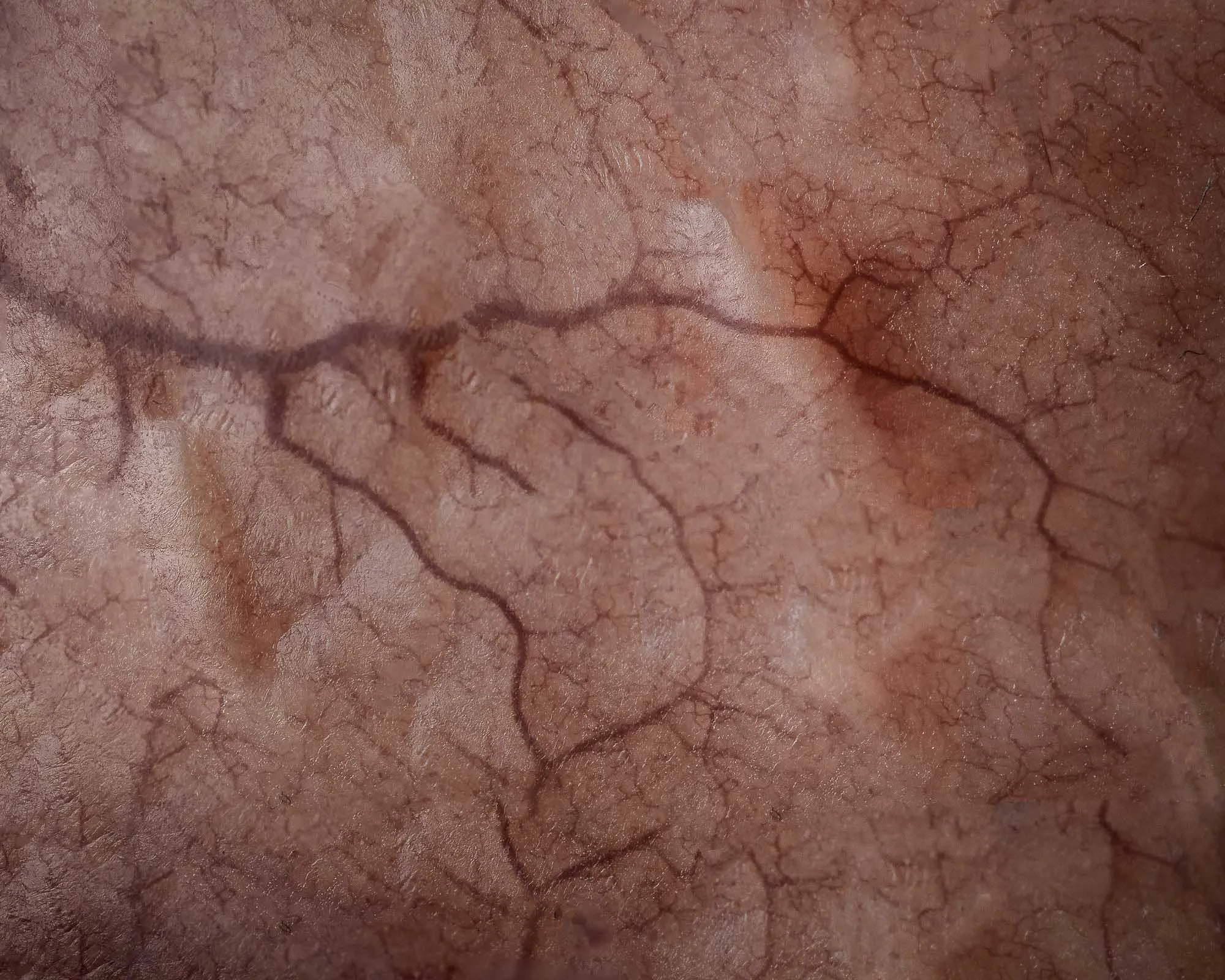
A Study of the Scrotum, by Neal Auch